Tuesday, 6 September 2011

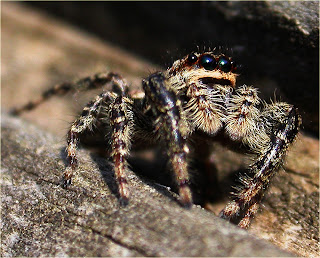
Fence-Post Jumping Spider - Marpissa muscosa

    Family - Salticidae
    Genus - Marpissa
    One of my favourite Spiders. Their large eyes and furry appearance
    give them a sense ofreal character.
    Their first pair of legs are chunkier and darker than the rest.
    The Males use these legs in courtship displays.
    They have amazing eyesight - binocular vision and elaborate focussing.
    Thought to be sensitive to colour as well as to polarized light.
    They often jump at my Camera Lens as they can see their own reflection.
    Some species of Jumping Spider can jump over twenty times their own length.


    Male sporting Purplish Palps - ready for mating (?)
    Living in the Pondhouse
    Stanmer Park
    01.09.2011

    Female
    Living in a Bird Hide
    Pulborough Brooks RSPB Nature Reserve
    11.07.2011
    Male sporting Golden Palps
    Stoneywish Nature Reserve
    Ditchling
    East Sussex
    22.07.2011
    Female hunting on a Wooden Bridge
    Woods Mill Nature Reserve
    Henfield
    East Sussex
    18.04.2011

Monday, 5 September 2011

Lepthyphantes sp.

    Family - Linyphiidae
    Genus - Lepthyphantes
    A type of Money Spider.
    Twenty-one species in the UK.
    Spins a Sheet Web.
    'Probably L. tenuis'
    Thanks to Peter Harvey of the British Arachnological Society.
    Said to be THE commonest spider in Britain!
    On a fence post at the edge of a field
    Stanmer, Brighton, East Sussex
    25.07.2011
    Found along the edge of a field
    Stanmer
    01.09.2011

Theridion sp.

    Family - Theridiidae
    Genus - Theridion
    Twenty-two species of Theridion in Northern Europe.
    Spins webs of criss-cross strands.

    'Theridion mystaceum/melanurum, can't be separated from photos and
    often pretty difficult even with adult epigyne/palp under a microscope.
    If from near buildings rather than semi natural habitat probably
    melanurum, although could still be either. Bird hide suggests melanurum
    most likely, but pure guesswork' Peter Harvey BAS   
    Living in a Bird Hide
    Arlington Reservoir
    East Sussex
    11.08.2011
    Brighton Extra Mural Cemetery
    23.09.2011

Simitidion sp.

    Family - Theridiidae
    Genus - Simitidion
    I thought this Spider was Lepthyphantes sp.
    I sent these photo's to Peter Harvey of the BAS.
    ''not Lepthyphantes, a theridiid, probably Simitidion
    (used to be Theridionsimile, from legs looks as though may be
    juvenile and pattern is variable so can't be absolutely sure, but shape
    and carapace colour suggests this. I can see why you thought
    Lepthyphantes though'.
    Brighton Extra Mural Cemetery
    03.08.2011

Cheiracanthium sp.

    Family - Clubionidae
    Genus - Cheiracanthium
    Eight European species of Cheiracanthium.
    First pair of legs are longer than Clubiona sp.making them distinguishable.
    Found in Silken retreats at the tops of Grass and also under stones.
    Greyish-brown abdomen with reddish median stripe and pale yellow
    stripes either side.

    Sheltering from the rain under a Gorse bush I spotted a small Silken retreat
    at the tip of some grass. I looked inside and this Spider popped out.
    I put her back in her retreat after taking these photo's.
    Lullington Heath, East Sussex
    04.09.2011
    I sent these photo's to Peter Harvey of the BAS for Id confirmation:
    'The Cheiracanthium is a juvenile which is almost certainly C. erraticum,
    but which could just possibly on southern heathland be the very similar
    C. pennyi, but this can't be distinguished without adult under microscope -
    outward appearance virtually identical'.   
    Wildlife Nature Reserve
    Tattershall Road
    Lincolnshire
    17.09.2011                  

Monday, 22 August 2011

Fen Raft Spider - Dolomedes plantarius

    Family - Pisauridae
    Genus - Dolomedes
    Fen Raft Spiders or Fishing Spiders are protected by Law.
    Only recordings are from Norfolk and Suffolk Fens and just one
    site in East Sussex. This site is managed by the Sussex Wildlife Trust,
    who were very kind to grant me a permit to visit this site to photograph 
    Dolomedes Plantarius. Many thanks to Alice Parfitt, Reserves Officer
    for Pevensey Marshes for granting the permit and for the map of where
    to find thriving Dolomedes ditches.
    I found eleven of them altogether. I feel honoured and privileged to
    have done so.  
    Six of the eleven, which I photographed, are featured here.
    I nearly fell in a few times and pulled various muscles to get some
    of these shots! Difficult terrain but a truly unique habitat.

    Lying in wait for prey. 
    These Spiders sit with their front legs resting on the
    surface of water. They catch insects, tadpoles and even
    small fish. They can also run across water to catch prey.
    They are able to hide underwater for nearly an hour, if threatened,
    by climbing down reeds and other aquatic plants.


    Dolomedes No.1


    Dolomedes No.2
    I found these two before I'd even entered the Reserve!


    Dolomedes No.3

    Dolomedes No.4


    Dolomedes No.5
    Dolomedes No.6

    Dolomedes 'Nursery'. The young leave this tent-like web, climb to
    higher, drier habitats and can be found in trees and bushes.


    Pevensey Marshes
    Sussex Wildlife Nature Reserve
    East Sussex
    20.08.2011