Thursday, 26 January 2012


Wednesday, 25 January 2012
Spiders of Nepal
My friend Gabrielle Lewry, very kindly sent me this photo
that she took of a beautiful Argiope sp. Gabrielle spotted the Spider,
whilst filming the rice harvest near Kathmandu, Nepal.

Photograph by Gabrielle Lewry
December 2014
::::::::::::::::::::
My friend Robert Hopkins sent me these excellent Photographs.
Robert travels to some remote places around the world and he has very
kindly given me permission to post his sightings on my Blog.
 Nephila sp. - a type of Orb Weaver. Although the Web
doesn't look particularly Orb shaped. She does look like she is
busy constructing her web as the photo was taken.
Robert tells me the Spider was the size of his palm.
Everest trek, Nepal
November 2011
 Nephila and her young? Robert tells me the web was 20-25 ft
above ground and that they were everywhere.
Everest trek, Nepal
Photographs by Robert Hopkins
November 2011
that she took of a beautiful Argiope sp. Gabrielle spotted the Spider,
whilst filming the rice harvest near Kathmandu, Nepal.
Photograph by Gabrielle Lewry
December 2014
::::::::::::::::::::
My friend Robert Hopkins sent me these excellent Photographs.
Robert travels to some remote places around the world and he has very
kindly given me permission to post his sightings on my Blog.

doesn't look particularly Orb shaped. She does look like she is
busy constructing her web as the photo was taken.
Robert tells me the Spider was the size of his palm.
Everest trek, Nepal
November 2011

above ground and that they were everywhere.
Everest trek, Nepal
Photographs by Robert Hopkins
November 2011
Spiders of Hawaii
My friend Ceridwen Falk very kindly sent me these Photographs she
took on Big Island, Hawaii.


Hawaiian Garden Spider.
Known locally as a Banana Spider.
They are also found in Taiwan and New Guinea.
Photographs by Ceridwen Falk
October 2010
Sunday, 22 January 2012
Segestria florentina - Tube Web Spider
Family - Segestriidae
Genus - Segestria
A large Tube Web Spider. Six eyes. Adults have Irridescent Green Chelicerae.
They are restricted to Southern UK with increasing numbers and
distribution. These impressive Spiders sit in wait in Tubular retreats in
walls, in the Bark of Trees, even under stones. The first three pairs of
legs point forward which they rest on 'Trip-Wires' extending from
their retreat. If anything touches the 'wires', the Spider will speedily rush
out and grab the prey in it's Jaws and also uses its forward pointing Legs
to clutch the prey in an almost hand-like movement.
The back pair of Legs act as a spring to launch at prey and to
retreat backwards into the hidden tube web. As illustrated in this video:

As I tweaked a Wire, she swiftly appeared at her doorway.
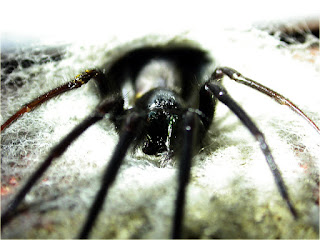 Poised for the Grabbing!


 I gently moved one of her front legs with a the end of a Pencil, to which she
stood her ground, reared up her front pair of legs and bit down on the
Pencil tip, twice. With some force, as I could feel it through the other end of
the Pencil.
I was tempted to let her bite me just to feel for myself but after sending the
above Video to Author Gordon Grice and reading his comment -
"I've read that the bite of these is not only mechanically painful, but also
has a toxic effect that feels like a deep stab wound for a few hours" - I am
glad that I didn't!
Quite a fierce Spider - the straw in the above video was considerably bigger
and much heavier than her - it didn't deter her. I figure she bit down on it a few
times after seeing the pencil attack. She still tried to drag it home, even though
it wasn't prey.
Torchlight usually makes them withdraw into their Lair, so it seems her instinct
to attack prey is stronger than it is to hide. Definately one of my favourite
Spiders.
 The Hand-like Legs configuration.
 The Fangs aren't that big but the Jaws/ Chelicerae are, and open wide for
repeated stabbing bites.

 I counted 51 Tubular Retreats with Trip Wires in a space of about 20
square feet. I observed hundreds of them over the course of a week.
Impressive Colonsiation I'd say. As a child in the 1970's, I was fascinated
with Spiders. I hunted high and low for them, all over Gosport, I never
once came across this species.
 Gosport, Hampshire
24.12.2011


 An exciting find for me.
Made me jump when she (I think a Juvenile Female) rushed out of her
tubular retreat in a wall.
Not the best photographs as I was a bit excited and in a hurry.
Musicroom Studios
Garden
New Cross
London
15.09.2011
Genus - Segestria
A large Tube Web Spider. Six eyes. Adults have Irridescent Green Chelicerae.
They are restricted to Southern UK with increasing numbers and
distribution. These impressive Spiders sit in wait in Tubular retreats in
walls, in the Bark of Trees, even under stones. The first three pairs of
legs point forward which they rest on 'Trip-Wires' extending from
their retreat. If anything touches the 'wires', the Spider will speedily rush
out and grab the prey in it's Jaws and also uses its forward pointing Legs
to clutch the prey in an almost hand-like movement.
The back pair of Legs act as a spring to launch at prey and to
retreat backwards into the hidden tube web. As illustrated in this video:

As I tweaked a Wire, she swiftly appeared at her doorway.


stood her ground, reared up her front pair of legs and bit down on the
Pencil tip, twice. With some force, as I could feel it through the other end of
the Pencil.
I was tempted to let her bite me just to feel for myself but after sending the
above Video to Author Gordon Grice and reading his comment -
"I've read that the bite of these is not only mechanically painful, but also
has a toxic effect that feels like a deep stab wound for a few hours" - I am
glad that I didn't!
Quite a fierce Spider - the straw in the above video was considerably bigger
and much heavier than her - it didn't deter her. I figure she bit down on it a few
times after seeing the pencil attack. She still tried to drag it home, even though
it wasn't prey.
Torchlight usually makes them withdraw into their Lair, so it seems her instinct
to attack prey is stronger than it is to hide. Definately one of my favourite
Spiders.


repeated stabbing bites.


square feet. I observed hundreds of them over the course of a week.
Impressive Colonsiation I'd say. As a child in the 1970's, I was fascinated
with Spiders. I hunted high and low for them, all over Gosport, I never
once came across this species.

24.12.2011


Made me jump when she (I think a Juvenile Female) rushed out of her
tubular retreat in a wall.
Not the best photographs as I was a bit excited and in a hurry.
Musicroom Studios
Garden
New Cross
London
15.09.2011
Saturday, 17 December 2011
Lace Webbed Spider - Amaurobius ferox
Family - Amaurobiidae
Genus - Amaurobius
A nocturnal Spider that spins a lacy, bluish web.
Found mainly under stones and logs.
The Male Palpal organs are very distinctive as they are white.
Female: 11-15mm / Male: 8-10mm
This photograph was very kindly sent to me by George Walker,
who found this Male in his Outhouse.
Many thanks to Peter Harvey of the BAS for help with identification.
 Photo by George Walker
Ogmore Vale
Wales
28.03.2011
Genus - Amaurobius
A nocturnal Spider that spins a lacy, bluish web.
Found mainly under stones and logs.
The Male Palpal organs are very distinctive as they are white.
Female: 11-15mm / Male: 8-10mm
This photograph was very kindly sent to me by George Walker,
who found this Male in his Outhouse.
Many thanks to Peter Harvey of the BAS for help with identification.

Ogmore Vale
Wales
28.03.2011
Monday, 12 December 2011
Pirate Spiders - Mimetidae
Family - Mimetidae
12 genera, 152 species
 Unusual Egg Sac.
I think this is the work of a Pirate Spider (Genus - Ero ?)
"..it could be Ero aphana, but I don't know how distinctive this is
in relation to other species". - Peter Harvey BAS
This Species preys on other Spiders by invading their webs.
Extra Mural Cemetery
Brighton
12.12.2011
 Second Egg Sac on the same Tomb
Extra Mural Cemetery
Brighton
13.12.2011

 Third Egg Sac
This one was under a Stone Urn, next to another Spider's Web.
Extra Mural Cemetery
Brighton, East Sussex
17.11.2011
12 genera, 152 species

I think this is the work of a Pirate Spider (Genus - Ero ?)
"..it could be Ero aphana, but I don't know how distinctive this is
in relation to other species". - Peter Harvey BAS
This Species preys on other Spiders by invading their webs.
Extra Mural Cemetery
Brighton
12.12.2011

Extra Mural Cemetery
Brighton
13.12.2011


This one was under a Stone Urn, next to another Spider's Web.
Extra Mural Cemetery
Brighton, East Sussex
17.11.2011
Tuesday, 6 December 2011
Argiope lobata
Family - Araneidae
Genus - Argiope
Male - 6mm / Female - upto 25mm
Known as the Lobed Argiope.
Quite a large Orb Weaving Spider found all over Africa and stretching
to Southern Europe and into Asia.
Distinctive zig-zag pattern/ ribboning (stabilimenta) emanating from the centre
of the Orb Web, thought to be a disguise from predators by camouflaging the
Spider or making it appear larger.
A relative of the UK's Wasp Spider - Argiope bruennichi.
Many thanks to Nick Loebner, who very kindly sent me these great
Photographs and recording information.

 Les Marines, Barcares Grande Plage.
Near Perpignan, Southern France.
10.09.2005
Photographs by Nick Loebner.
Genus - Argiope
Male - 6mm / Female - upto 25mm
Known as the Lobed Argiope.
Quite a large Orb Weaving Spider found all over Africa and stretching
to Southern Europe and into Asia.
Distinctive zig-zag pattern/ ribboning (stabilimenta) emanating from the centre
of the Orb Web, thought to be a disguise from predators by camouflaging the
Spider or making it appear larger.
A relative of the UK's Wasp Spider - Argiope bruennichi.
Many thanks to Nick Loebner, who very kindly sent me these great
Photographs and recording information.


Near Perpignan, Southern France.
10.09.2005
Photographs by Nick Loebner.
Subscribe to:
Posts (Atom)